Facade sandblasting
When the process suits render, clinker brick and natural stone – and where caution is needed.
Read the guidePainted-over graffiti often bleeds through again, and harsh chemicals burden both the environment and the substrate. Gentle blasting removes the paint mechanically – here you can read how it works and what to realistically expect.
The process
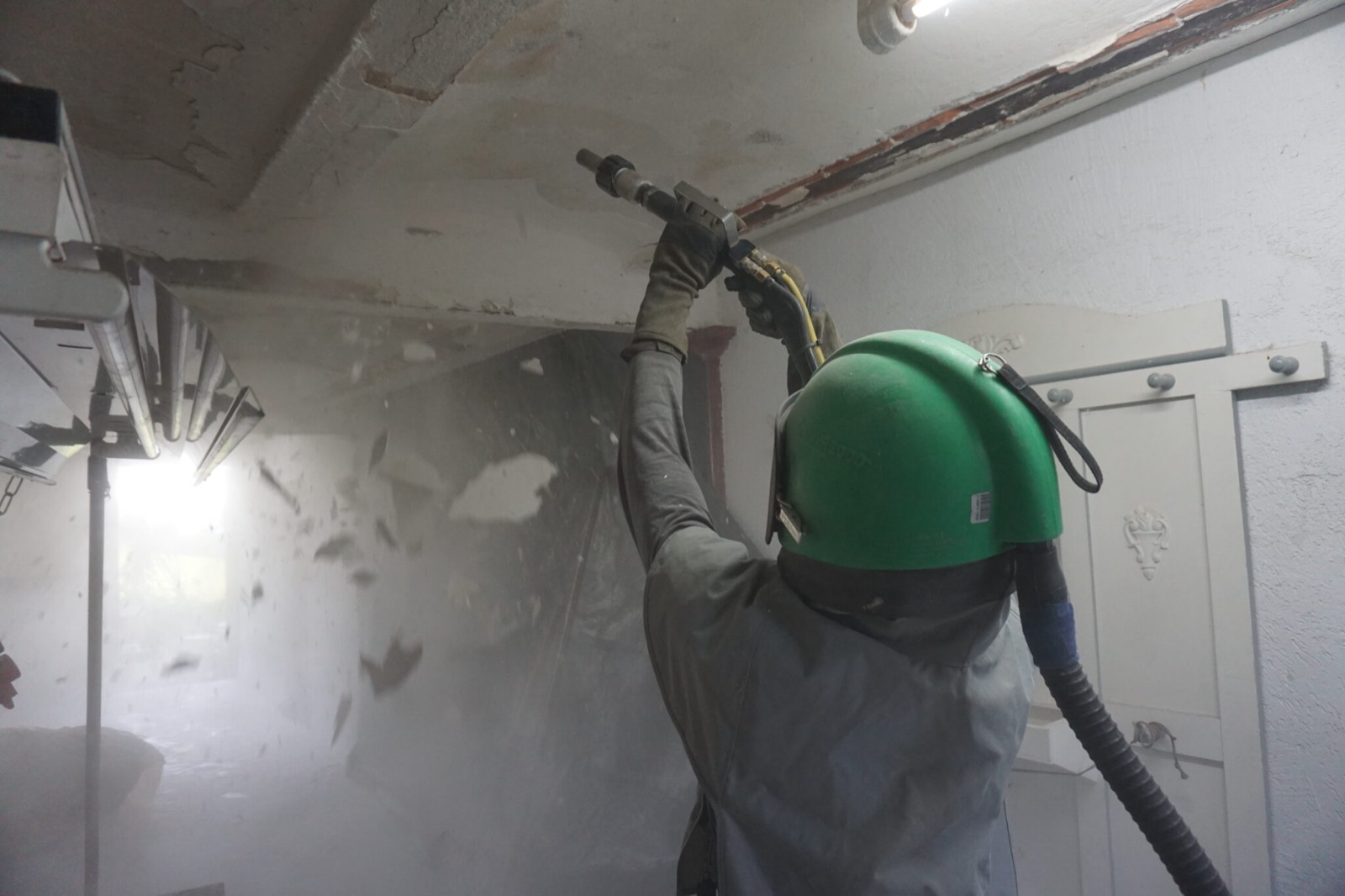
Graffiti paint sits as a thin layer on top of, or in, the uppermost pores of the substrate. With fine blast media and greatly reduced pressure we remove exactly this layer – in a controlled way, without attacking the substrate over a wide area and without solvents. We adapt process and grit to the substrate, on sensitive surfaces after a test patch.
One principle up front: the fresher the graffiti, the better the result. Paint that has sat in porous material for weeks or months migrates deeper with sun and rain. Acting quickly saves effort and produces the cleanest result.
Substrates
Concrete and exposed concrete are robust and usually clean up very well – results here are generally the best. Clinker brick demands respect for its protective fired skin: fine grit, moderate pressure, test patch.
Rendered and painted facades have one particularity: along with the graffiti, the paint at that spot is inevitably removed as well. The cleaned area usually has to be repainted afterwards – on older facades ideally the whole wall, so no patchwork effect arises. Porous natural stone is the hardest case: pigments can penetrate deeply, so especially careful, step-by-step work is required.
Honestly speaking
Where pigments have penetrated deeply, a pale residual shadow can remain in the stone after cleaning – the so-called ghost image. The alternatives: blast more intensively and sacrifice more substance, or accept the shadow or refinish the surface. What makes sense depends on the substrate and your expectations.
We tell you honestly before the job what result to expect – after an inspection, and in case of doubt after a test patch. That way you decide on a realistic basis instead of on promises.
Prevention
If you are affected regularly – on house walls along footpaths, underpasses, rows of garages – you can take precautions: anti-graffiti coatings prevent paint from penetrating the substrate. There are semi-permanent (sacrificial) systems – a protective layer that is removed together with the graffiti and then renewed – and permanent coatings from which paint is much easier to remove. Such coatings are applied by painting and coating specialists – we take care of thoroughly removing existing graffiti.
The next removal then becomes faster, cheaper and gentler. Whether it is worthwhile for your surface is something we are happy to discuss during the first cleaning.
Frequently asked questions
Keep reading
When the process suits render, clinker brick and natural stone – and where caution is needed.
Read the guideThe key cost factors honestly explained – and how to get a fixed quote quickly.
Read the guideOur service against spray paint at a glance – including preventive protection.
View serviceFree & no obligation
Send us a photo of the affected surface – we will tell you honestly what result is possible, and name the price.