Wood sandblasting
Gently free beams, timber framing and staircases from paint and grey weathering.
Read the guideSame machine, different blast media – a completely different result: hardness, grain size and grain shape determine whether a surface is cleaned gently or stripped powerfully. An overview of the most important media.
The basics
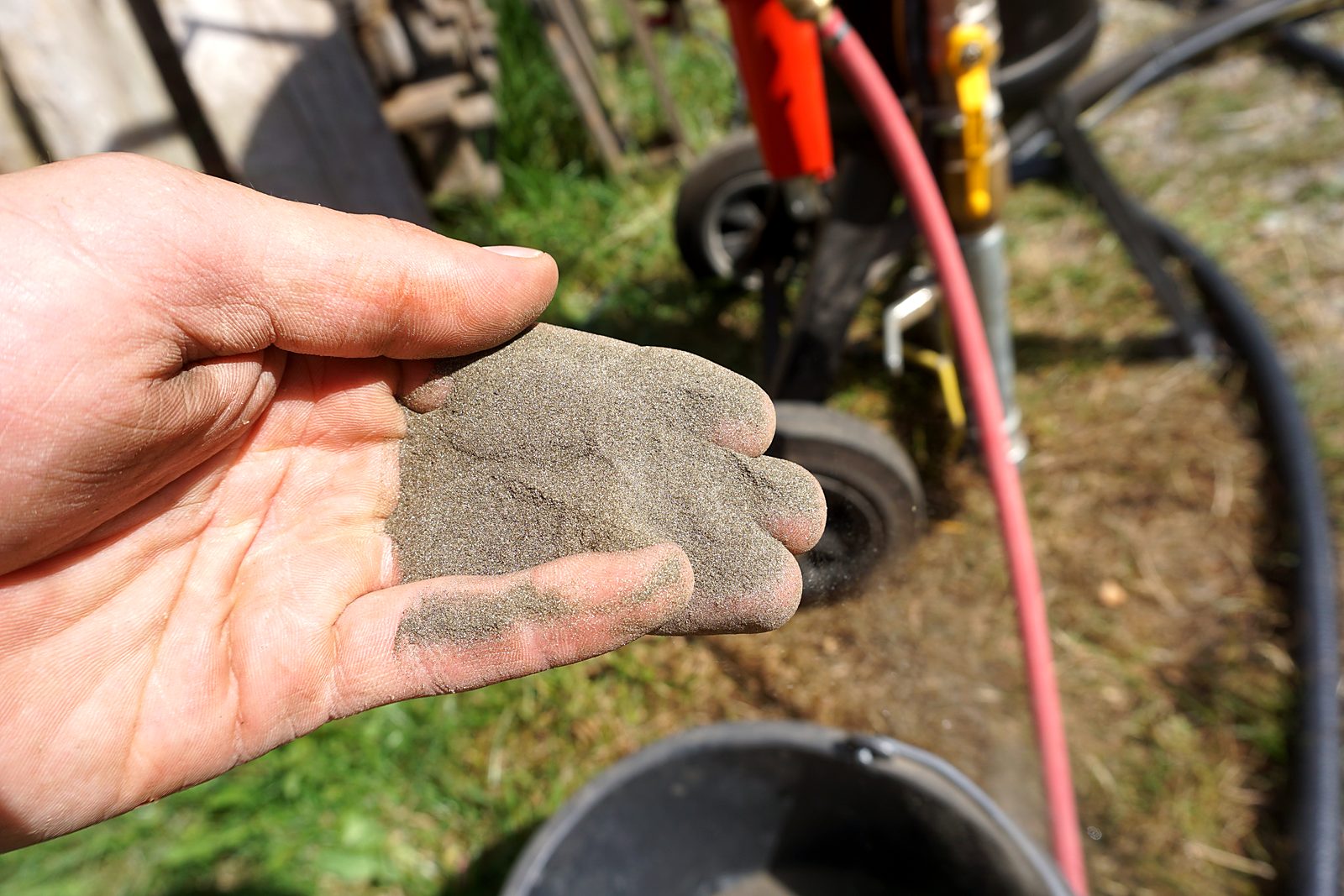
Three properties determine the effect of a blast media: its hardness (how aggressively it removes material), its grain size (how fine or coarse the surface becomes) and its grain shape – angular grains cut and roughen, round grains hammer and tend to compact the surface.
By the way: real quartz sand has long since disappeared from blasting – it has been banned for blasting work in Germany for decades on occupational-safety grounds, because its fine quartz dust damages the lungs (silicosis). 'Sandblasting' is simply the name that history left behind; today the work is done with low-quartz and quartz-free media.
And the blast media is only half the story: pressure, nozzle distance and working angle also determine how gently or powerfully the grain acts. The same media can strip a wooden door gently at reduced pressure and de-scale steel at full pressure – the right combination is a matter of experience.
The overview
Mineral blasting media such as garnet sand or smelting slag are the workhorses: economical, available in many grain sizes and suitable for steel, masonry and robust surfaces – from rust removal to facade cleaning.
Corundum (aluminium oxide) is very hard and angular: it removes material powerfully and produces a precise, defined roughness profile – ideal when the coater specifies a certain roughness depth or when hard materials are being treated.
Glass beads are round and work quite differently: instead of cutting, they compact the surface and leave a satin-matt, uniform finish. Perfect for aluminium, stainless steel and delicate parts where substance and dimensions must be preserved.
Very mild media – walnut shell granulate, for example, or the finest grain sizes at reduced pressure – are used on delicate substrates such as wood, thin sheet metal or historic details: they release coatings without attacking the substance.
Selection & environment
The choice is always a trade-off along a few criteria:
On the environmental side: we rely on mineral, inert blasting media and favour environmentally sound products when selecting them. The spent media is collected and disposed of properly – if the removed material contains old, contaminated coatings, the applicable disposal regulations are followed.
Frequently asked questions
Keep reading
Gently free beams, timber framing and staircases from paint and grey weathering.
Read the guideRemove rust completely, understand Sa preparation grades and build up corrosion protection properly.
Read the guideOur core process at a glance: equipment, workflow and applications at Sandblitz.
View serviceFree & no obligation
Send us photos – we will choose the process and blast media to suit the material and advise you honestly.